Who We Are
CCS administers and enforces competition and consumer protection laws in Singapore to guard against anti-competitive activities and unfair trade practices, and ensure fair trade measurement practices and the supply of safe consumer goods.
Last updated 8 July 2026
Overview
The Competition Commission of Singapore was established on 1 January 2005 to administer and enforce the Competition Act 2004. On 1 April 2018, the Competition Commission of Singapore took on an additional function of administering the Consumer Protection (Fair Trading) Act 2003, and was renamed the Competition and Consumer Commission of Singapore. From 1 July 2025, the Competition and Consumer Commission of Singapore expanded its mandate to ensure that businesses observe fair trade measurement practices by administering the Weights and Measures Act 1975, and ensuring the supply of safe consumer goods by enforcing and implementing the Consumer Protection (Trade Descriptions and Safety Requirements) Act 1975 and its associated Regulations.
The Competition and Consumer Commission of Singapore (“CCS”) represents Singapore internationally on competition matters, consumer protection and legal metrology. CCS also has a statutory duty to advise the government, other public authorities, and consumer protection organisations on national needs and policies in respect of competition matters, consumer protection, and legal metrology generally.
Functions and Duties
The functions and duties of the CCS are to:
Maintain and enhance efficient market conduct and promote overall productivity, innovation, and competitiveness of markets in Singapore;
Eliminate or control practices having adverse effect on competition in Singapore;
Promote and sustain competition in markets in Singapore;
Promote a strong competitive culture and environment throughout the economy in Singapore;
Act internationally as the national body representative of Singapore in respect of competition matters, consumer protection and legal metrology;
Promote fair trading practices among suppliers and consumers and enable consumers to make informed purchasing decisions in Singapore;
Promote among suppliers in Singapore, and educate consumers on, the following practices:
the supply of safe consumer goods;
the provision of relevant safety information about consumer goods;
legal metrology
Prevent suppliers in Singapore from engaging in unfair practices and prevent the supply of unsafe consumer goods in Singapore;
Administer and enforce the Consumer Protection (Fair Trading) Act 2003;
Administer and enforce the Weights and Measures Act 1975 and
Advise the Government, other public authorities or consumer protection organisations on national needs and policies in respect of competition matters, consumer protection and legal metrology generally.
Divisions in CCS
Legal and Enforcement (LE) Group:
The LE Group comprises legally-trained officers that work closely with the Economics, Policy and Data (EPD) Divisions, as well as the Consumers Group, to administer, implement and enforce the laws that come under CCS’s purview. As supervisors, leaders, or members of cross-divisional case teams, LE officers apply rigorous legal analysis to assessments and investigations by CCS, undertake reviews to update applicable laws and legal frameworks, render competition advice to public agencies, and represent CCS in court and appeal proceedings.
Legal Division:
Separately, the Legal Division takes the lead in providing all in-house legal advice and services associated with the execution of CCS's functions.Enforcement Division:
Separately, the Enforcement Division takes the lead in providing CCS with enforcement and intelligence capabilities to enable CCS to fulfil its mission.
Consumers Group
The Consumers Group consist of two Divisions – The Fair Trading Practices Division and the Product Safety, Weights & Measures Division. They work together to promote consumer protection and an accurate system of weights and measures in Singapore, and collaborate with stakeholders to ensure fair business conduct to create a safe and fair marketplace for consumers.
Fair Trading Practices (FTP) Division:
The FTP Division administers and enforces the Consumer Protection (Fair Trading) Act (CPFTA) to prevent suppliers in Singapore from engaging in unfair practices.Product Safety, Weights & Measures (PW) Division:
The PW Division administers, implements and enforces the Consumer Protection (Safety Requirements) Regulations, the Consumer Protection (Consumer Goods Safety Requirements) Regulations and the Weights and Measures Act to ensure consumer product safety and a uniform and accurate system of weights and measures.
Economics, Policy and Data (EPD):
EPD undertakes economic analysis in support of CCS’s enforcement and advocacy functions with respect to competition and consumer protection issues, working closely with Legal, Enforcement and Consumer Protection Divisions. EPD consists of 3 divisions – Business and Economics, Government Advocacy and Markets, and Data and Digital.
Business and Economics (BE) Division:
The BE Division takes the lead in researching and analysing economic and behavioural issues to ensure that CCS’s economic assessment framework and tools are robust and updated. It also advocates fair and competitive business practices to professional bodies and business communities.Government Advocacy and Markets (GAM) Division:
The GAM Division takes the lead in engaging and advising government agencies on competition matters. In addition, the GAM Division takes the lead in the identification and conduct of market studies to address competition and consumer protection issues.Data and Digital (D2) Division:
The D2 Division harnesses technology to improve the efficiency and effectiveness of CCS, performs data analytics to better inform our decision-making processes and institutionalises knowledge in digital markets, so as to augment CCS’s enforcement and advocacy functions with respect to competition and consumer protection issues in digital markets and beyond.
Corporate Affairs (CA) Division:
The CA Division supports the Divisions in achieving CCS’s mission through the delivery of key corporate services critical to the success of the organisation. Primarily, the CA Division oversees the functions of human resource, finance, procurement, information technology and office administration. It strives to nurture a productive, engaged and future-ready workforce and make CCS an excellent workplace by enhancing the effectiveness and efficiency of our corporate systems and processes.
International, Communications & Planning (ICP) Division:
The work of the ICP Division encompasses strategy development, corporate communications, international affairs and organisational excellence. The ICP Division works in close partnership with other divisions in CCS to chart long-term organisation growth, track organisation performance, as well as to formulate strategies and execute programmes in the areas of advocacy, outreach, external communications and international engagement.
CCS cooperation with foreign counterparts
As the national body representative of Singapore in respect of competition and consumer protection matters, the CCS also works with its foreign counterparts to foster cooperation on cross-border cases and to promote development and implementation of competition and consumer protection laws and policies. They include:
Entering into agreements with foreign competition agencies, eg, negotiating FTAs with competition and consumer protection provisions to establish a level playing field for businesses and to safeguard consumers' interests;
Forging strategic engagements with key foreign counterparts to foster closer cooperation in competition and consumer protection related matters;
Participating and contributing actively at the various international fora to shape the development and implementation of competition and consumer protection policies and law;
Addressing relevant emerging trends and developments, as well as adopting applicable international best practices, to ensure our competition and consumer protection regime remains robust in Singapore.
Strategic Framework and Priority Areas
FY2026-30 Strategic Framework
CCS's FY2026–30 Strategic Framework outlines five priority areas that will guide our work in strengthening competition and consumer protection amid evolving market challenges. Together, these priorities support a competitive, innovative and trusted marketplace that benefits businesses and consumers in Singapore.
Priority Areas
Priority Area 1: Trusted Enforcement for a Changing Economy
CCS will continue to strengthen competition enforcement while adapting to new forms of market power and consumer vulnerability in digital markets. This requires more agile processes and a stronger enforcement toolkit for digital markets. Our approach will incorporate multidisciplinary capabilities, including AI, behavioural science and digital forensics, to address the complexities of modern markets.
Priority Area 2: Developmental Partner of Singapore's Businesses
CCS will strengthen its role as an economic agency by applying competition policy more intentionally to support innovation and business growth. We will continue to work with stakeholders to shape competitive markets, including through market studies and advisories.
Priority Area 3: Empowered Consumers in a Digital Age
As e-commerce continues to grow, CCS will strengthen consumer protection by reviewing its enforcement philosophy for fair trading practices. We will also enhance consumer education through digital outreach to build consumer resilience and promote informed decision-making.
Priority Area 4: Cross-Border Partnerships for Growth and Opportunities
CCS will continue to deepen partnerships with international counterparts and contribute actively to regional and international forums. We will leverage competition policy to support Singapore's strategic interests, facilitate businesses' regional expansion and strengthen Singapore's thought leadership.
Priority Area 5: Future-Ready Capabilities, People and Systems
CCS will strengthen its organisational capabilities by reshaping how we organise work, develop our people and deploy technology. Through strategic workforce planning and greater use of AI, we will improve productivity, enhance enforcement and build the capabilities needed for the future.
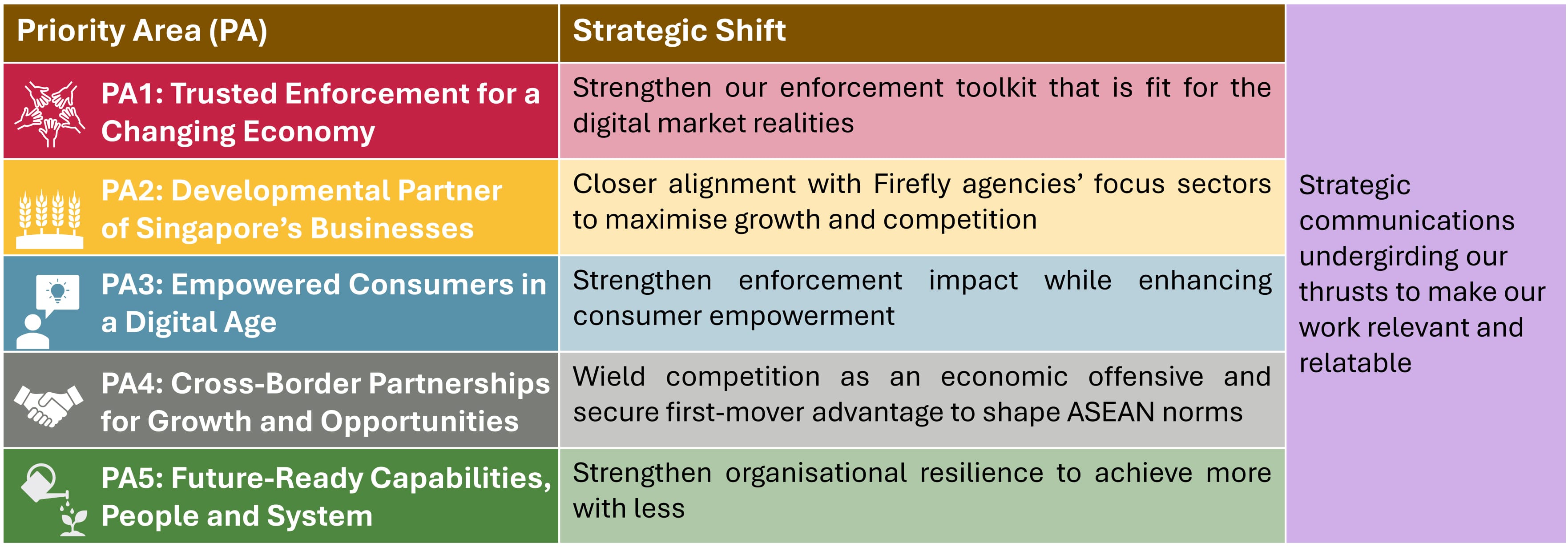
FY26-30 Strategic Framework Table